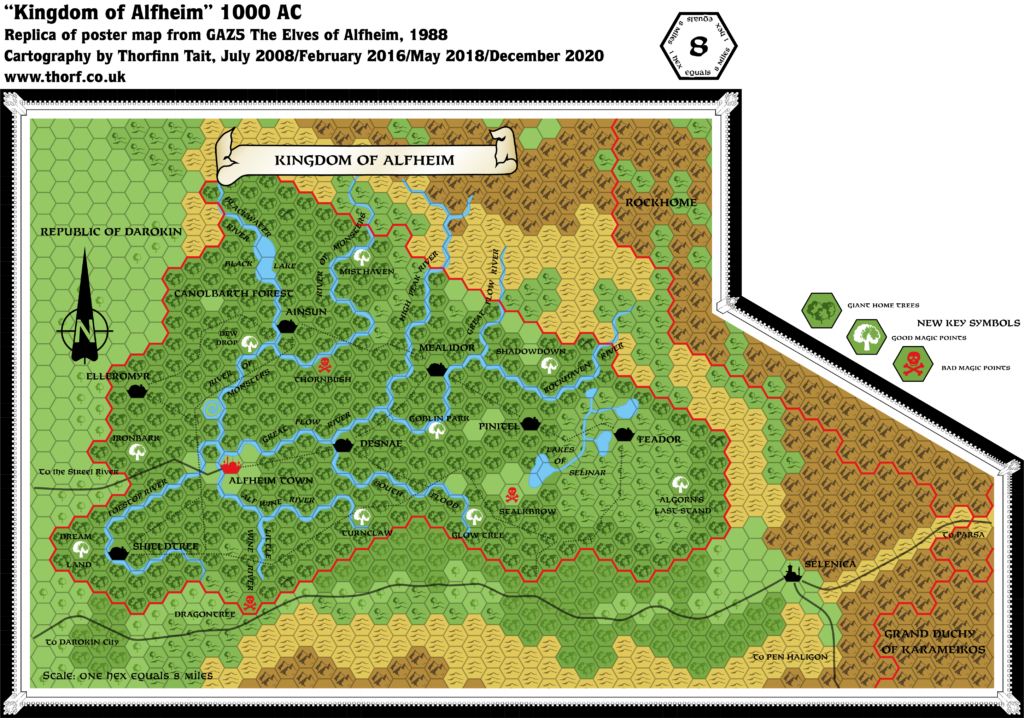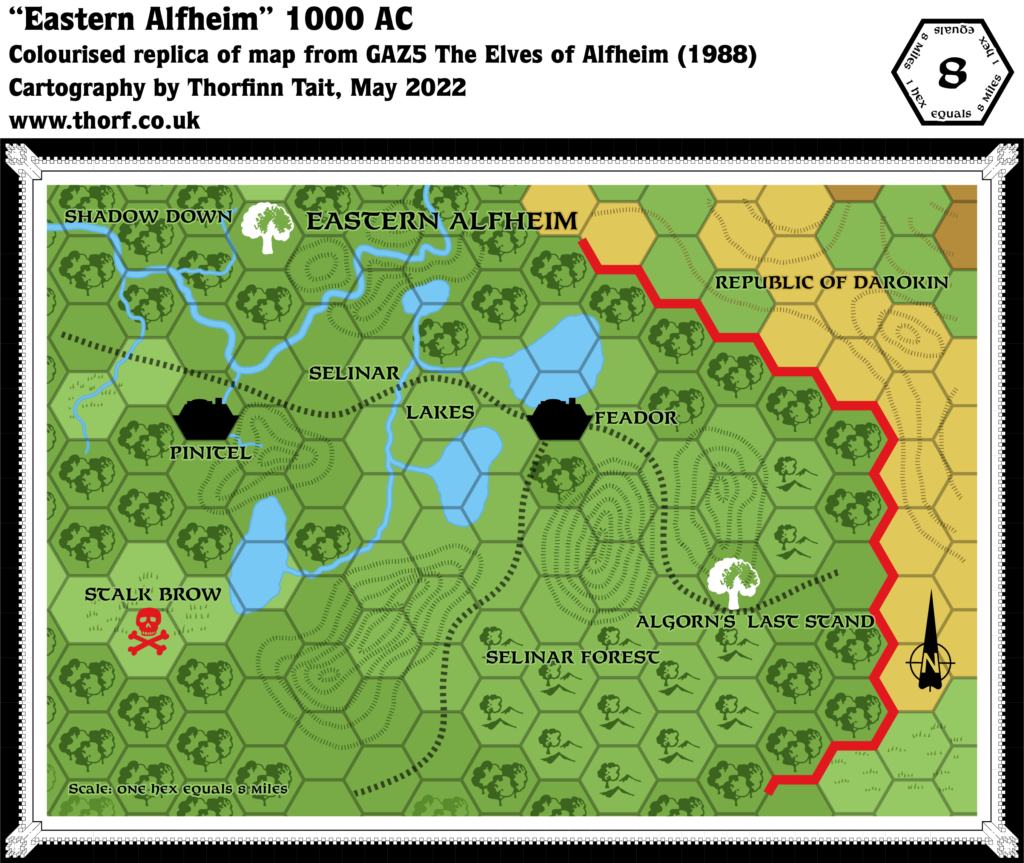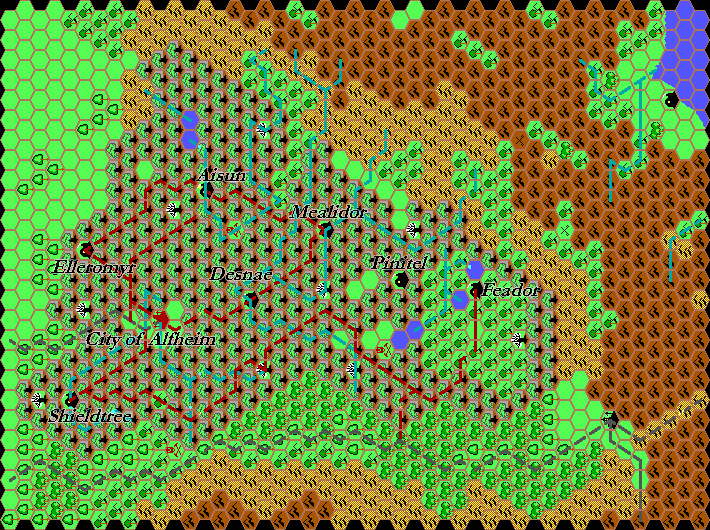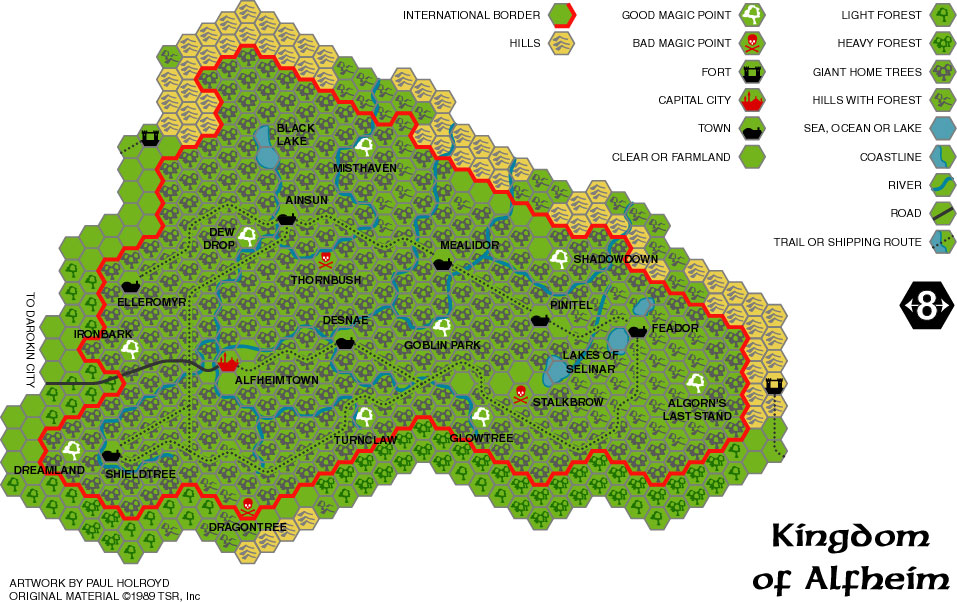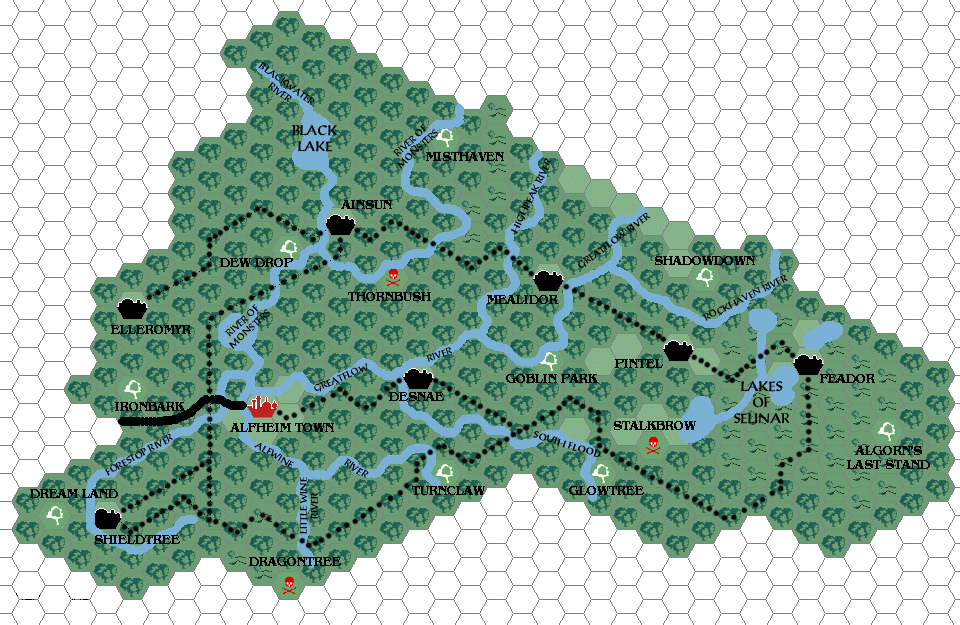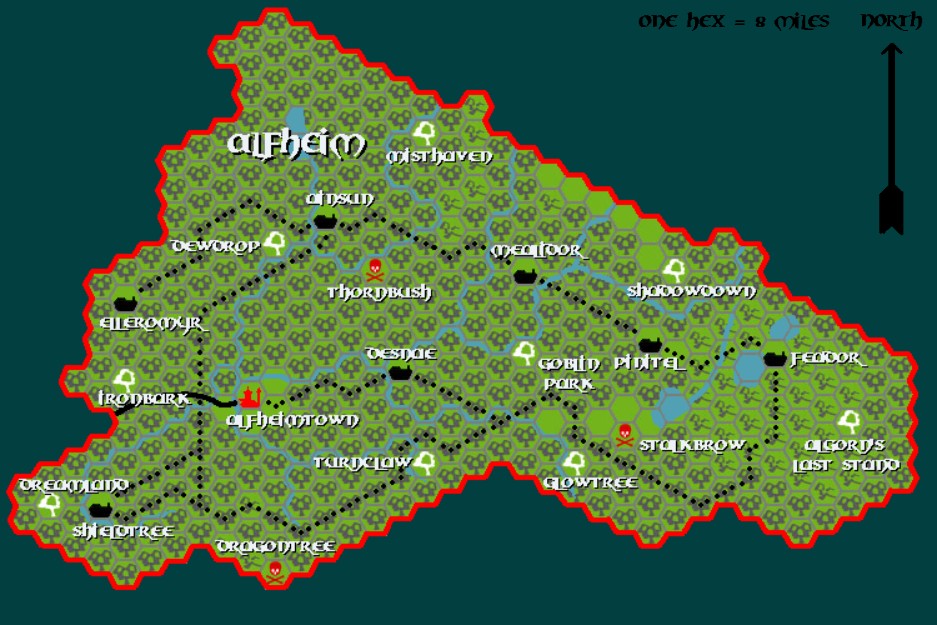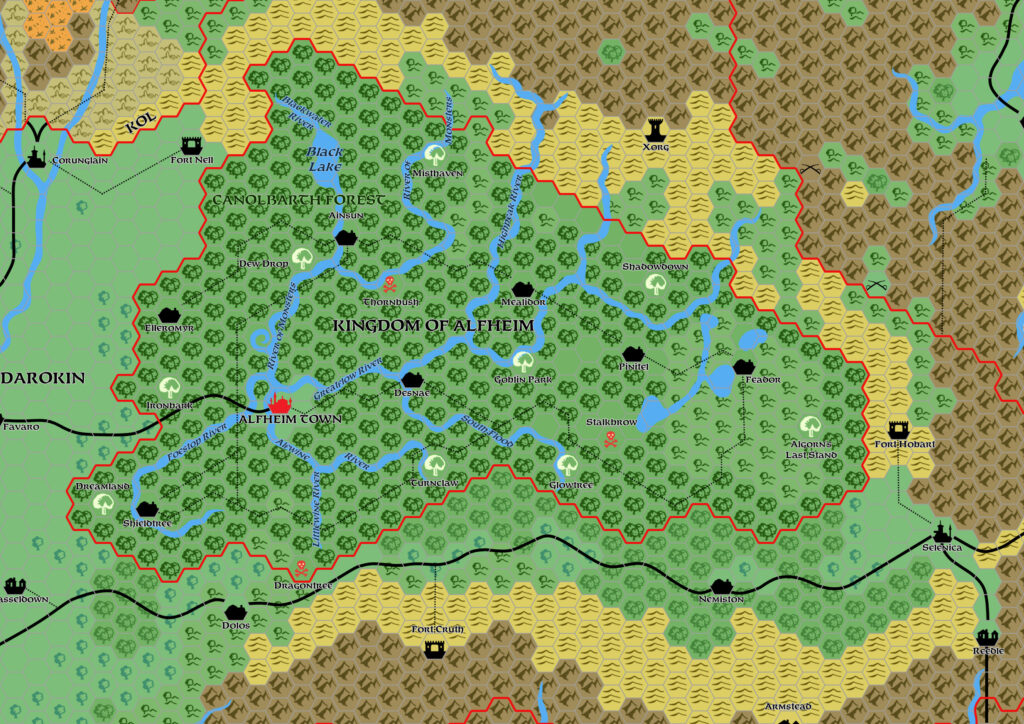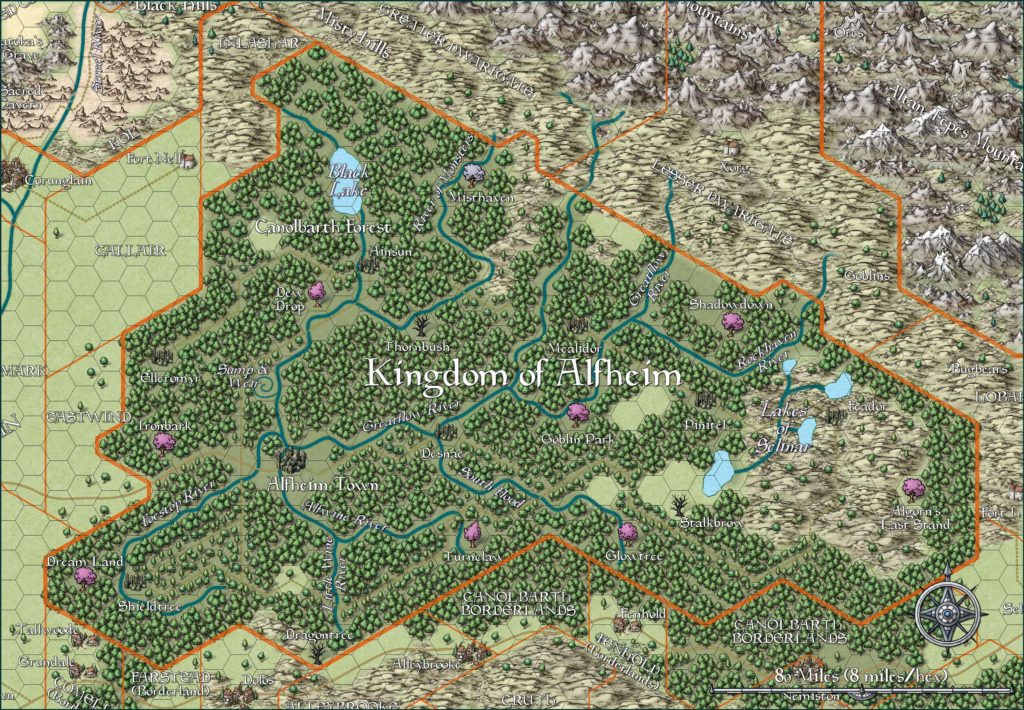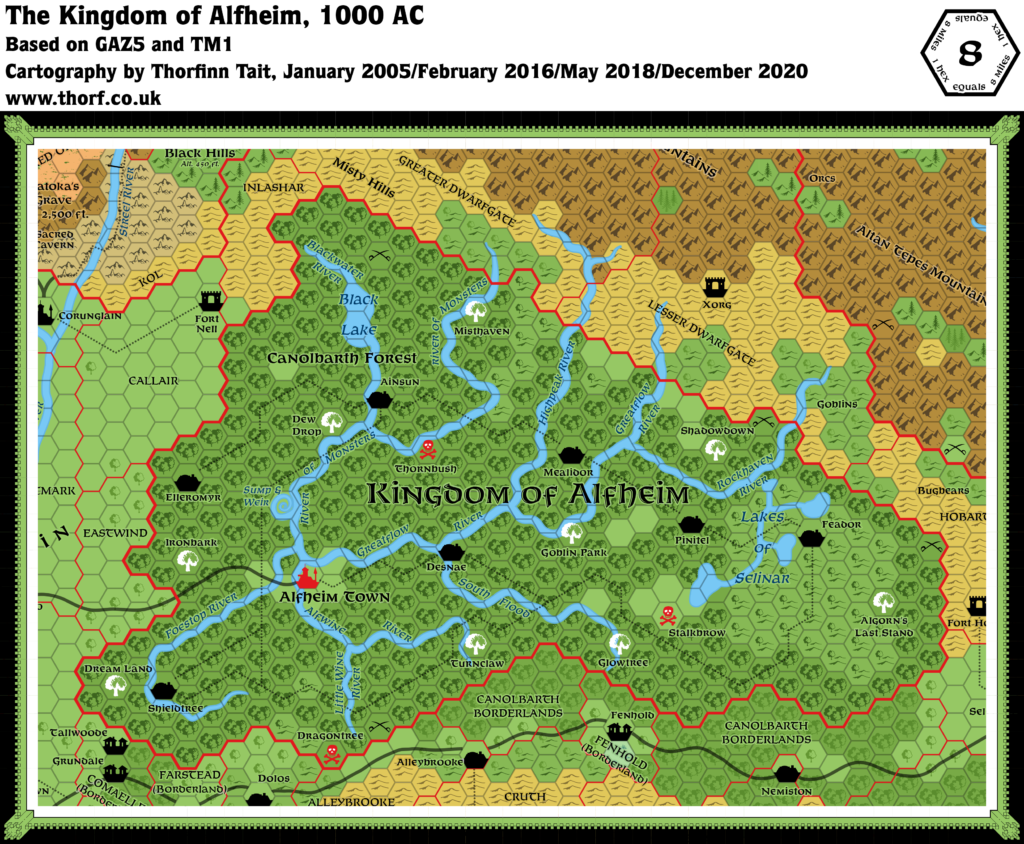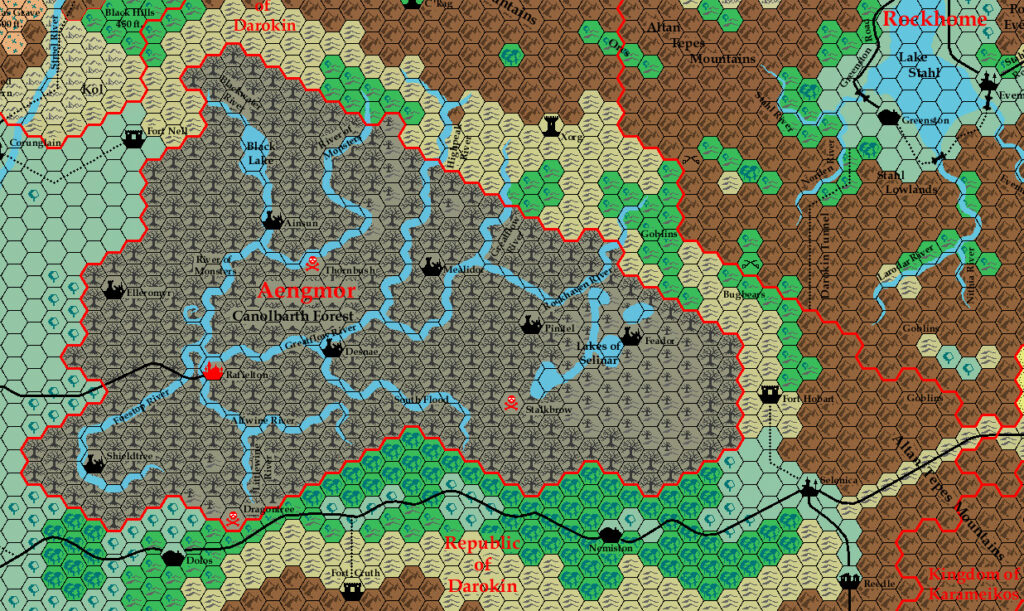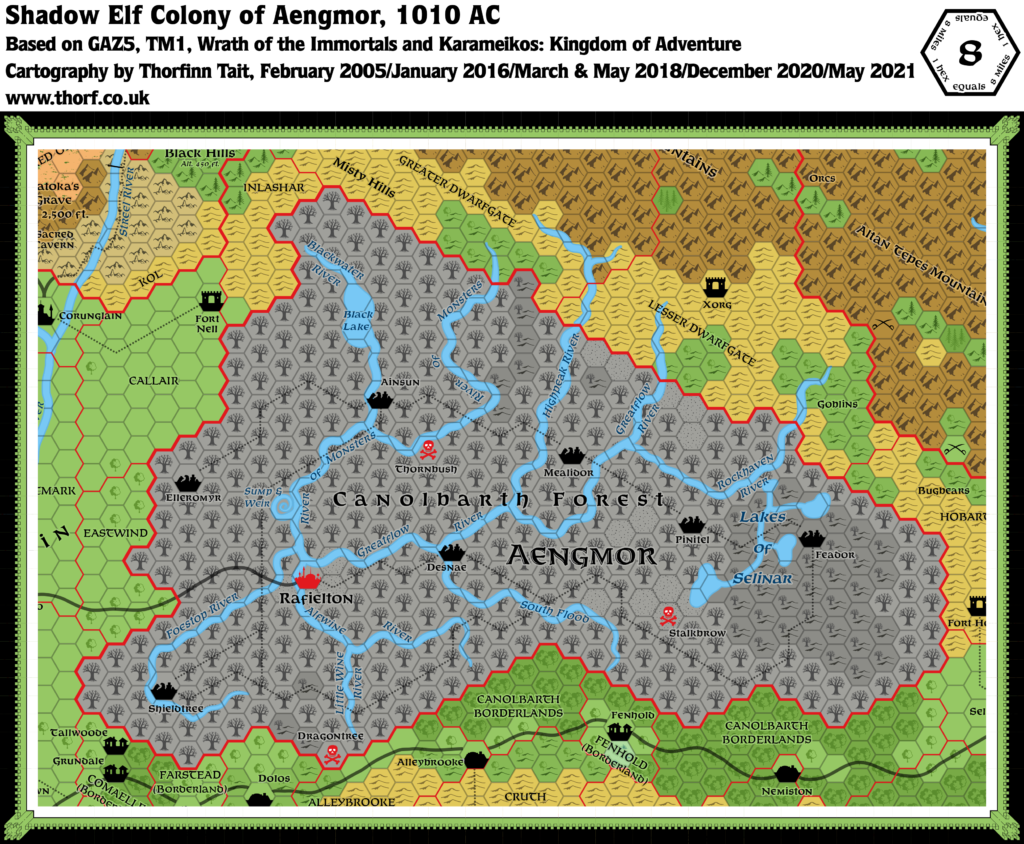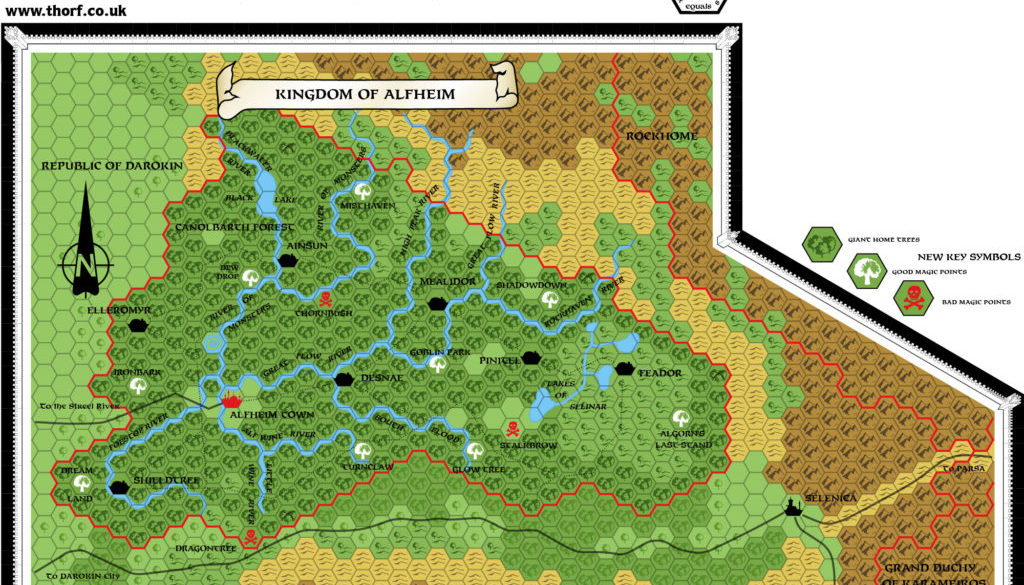
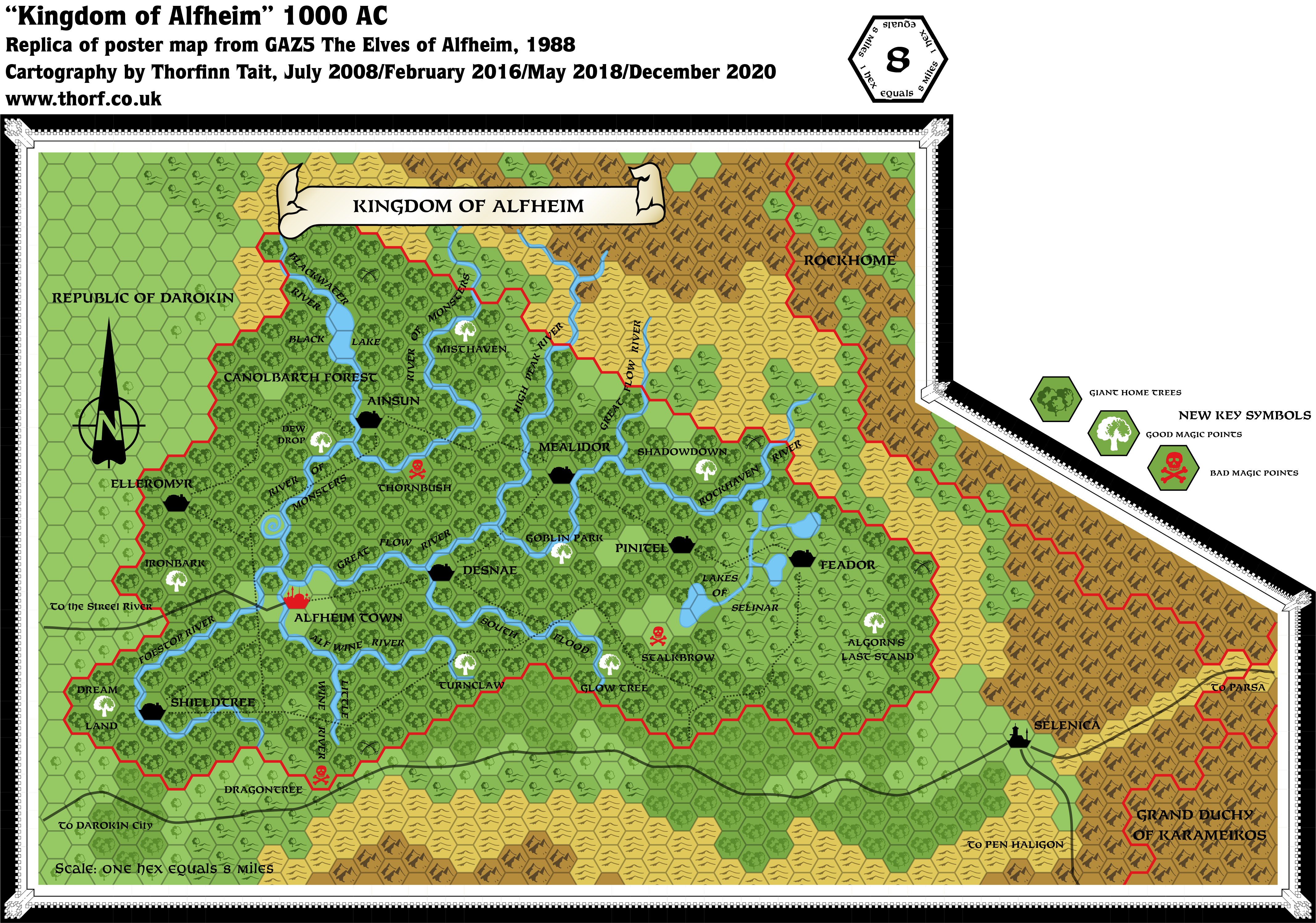
GAZ5 Alfheim, 8 miles per hex
All of Alfheim’s rivers flow towards the sump & weir, marked on the map as a spiral. From there, they drain underground. GAZ5 unfortunately continued GAZ2’s trend of not marking villages on the map. It introduced two new symbols for good and bad magic points, and used a palette change for the great home trees of the Canolbarth Forest.
Replica Map (December 2020)
Sources
- GAZ5 The Elves of Alfheim (1988) (PDF at DriveThruRPG)
- Poster map (Cartography by Dave Sutherland, Dennis Kauth)
Chronological Analysis
This is Map 82. It was published in March 1988. The updated version of this map is available here. See also Appendix C for annual chronological snapshots of the area. For the full context of this map in Mystara’s publication history, see the upcoming Let’s Map Mystara 1988.
The following lists are from the Let’s Map Mystara project. Additions are new features, introduced in this map. Revisions are changes to previously-introduced features. Hex Art & Fonts track design elements. Finally, Textual Additions are potential features found in the related text. In most cases, the Atlas adopts these textual additions into updated and chronological maps.
Under Construction! Please check back again soon for updates.
Additions
- Settlements —
- Terrain —
Revisions
- Settlements —
- Terrain —
Hex Art & Fonts
- Symbols — Gazetteer series standard. New symbols for Good Magic Point (a white tree), Bad Magic Point (a red skull and crossbones), and Great Home Trees (heavy forest with the trees in a darker shade of green).
- Fonts — Feinen throughout.

Textual Additions (GAZ5, 1988)
- History — GAZ5 provides various details that could be used to map out the area’s geography over time.
- 800 BC – the area’s pre-Canolbarth state is described as “the wind-torn steppes of what is now Alfheim.” (GAZ5 page 8a) “The surrounding human tribes let them stay, certain that the elves would starve and wither in that forbidding place.” (ibid) We can deduce that the steppes area was poor land, and largely unsettled by humans.
- 800 BC – c. 500 BC – “Earth which had rarely tasted rain before was suddenly filled to excess and the plants bloomed. … Scrub oak grew and flourished. Water-starved steppes plants suddenly changed and adapted almost overnight. In a few centuries’ time, the steppes became a forest… the Canolbarth. At the same time, elven adventurers stole through human lands to bring back forest animals to the Canolbarth.” (GAZ5 page 8a) This description seems to imply that the evolution of the Canolbarth Forest was quite rapid at first, but nevertheless took hundreds of years to reach its 1000 AC extent and condition.
- c. 500 BC – “This time was also the start of the decline of the Nithian empire. Ilsundal knew of the Immortals’ curse on that unhappy land … and his part of the curse diverted much of what had made the Nithians great towards his children, the elves.” (GAZ5 page 8a) The phrase “this time” is ambiguous, but it likely means 500 BC, since this was the date of the Nithians’ destruction. Ilsundal’s part of the curse likely involved diverting rainfall away from Ylaruam and onto Alfheim. The Weatherchange section on pages 16c and 17a of GAZ5 makes this clearer: “…through the intervention of the Immortal Ilsundal. Climatic changes were willed upon the continent, taking water from naturally wet lands with direct access to the sea and lofting it over the barrier mountains to provide rain for Alfheim. Actually, most of the moisture falling upon Alfheim is gathered over the oceans surrounding the continent, but there is an overlap which affects the continental climate (some speculate that it was deliberate, calculated to insure that certain neighbours of Alfheim would be weakened).” (GAZ5 pages 16c and 17a)
- Migrations — The movements of the elves over time were given particular attention in GAZ5.
- Migrations 800 BC – “Several thousand elves took the Rainbow Path to a relatively unsettled area, what is now Thyatis, 800 years prior to the crowning of the first emperor in Thyatis. … Harrassed and deceived at every turn, the elves fled northward. Some stopped in what is now Karameikos and became the Calarii elven clan … but most stopped in the wind-torn steppes of what is now Alfheim.” (GAZ5 pages 7c-8a)